This blog post was written for Fidulex Fiduciary. The full post is available on the business’ website.
Wealth Tax: What Is It?
In Switzerland, the wealth tax is levied by the cantons and municipalities on the total value of an individual’s personal property and assets.
This tax is based on the net wealth of the taxpayer, i.e. all assets, excluding debts.
Unlike the income tax, which is based on a person’s annual income, the wealth tax focuses on accumulated wealth. The wealth tax is also typically lower than income tax.
The wealth tax is part of the cantonal taxes and is levied only by the canton of residence or by the state in which a property is.
This competence was entrusted to the cantons by the Confederation and has been codified by art 2 of the LHID.
Taxable Wealth
The following is a non-exhaustive list of items subject to wealth tax. These items may vary from canton to canton.
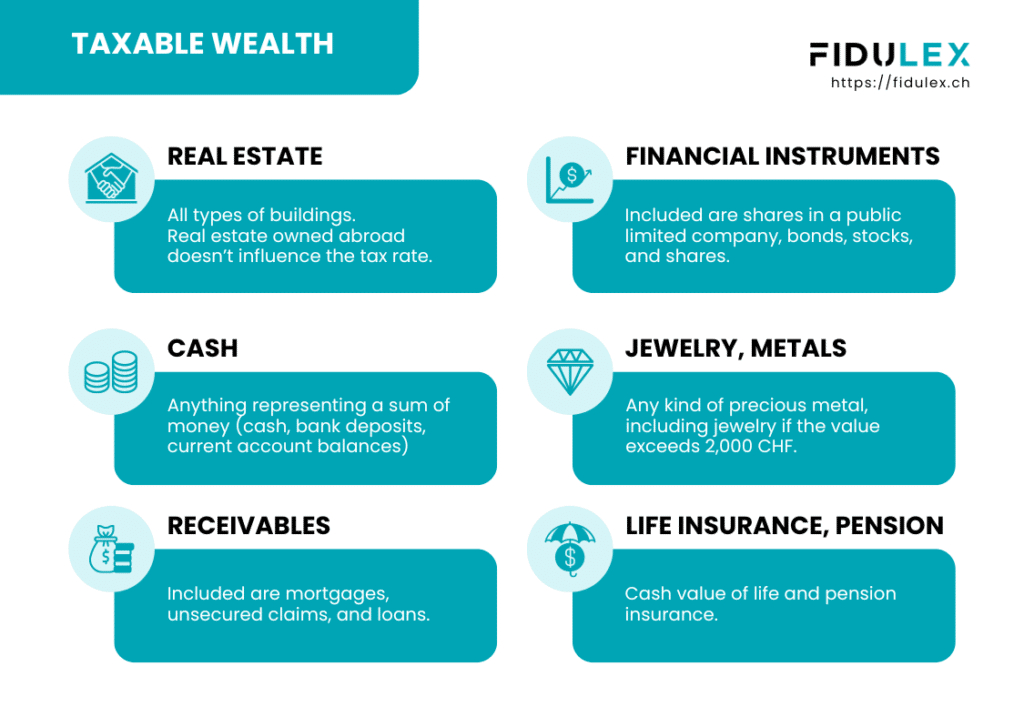
Real Estate : This covers all types of buildings.
It should also be noted that real estate owned abroad does not influence the tax rate, although it must be declared.
Please check, however, that the country where you own your property does not have a double taxation agreement with Switzerland. The neighbouring country of France, for example, has such an agreement with Switzerland.
Financial Instruments: This category includes items such as shares in a public limited company, bonds, stocks, and shares in companies or associations.
Cash and bank deposits: Any asset representing a monetary value. This can be things such as cash, bank deposits, and current account balances.
Collective investment units: The difference between the total value of the investment’s assets and the value of its real estate.
Receivables: Mortgages and unsecured claims.
Commercial Fortune: All elements of business assets.
Life Insurance & Pensions: Such as the cash value of life and pension insurance.
Jewellery and Silverware: These are included in this category only if their value exceeds CHF 2,000.
Precious Metals: Gold, silver, or platinum, for example.
Livestock: Included here are both dead and live cattle.
Non-Taxable Wealth
Furniture and Collections: Furniture, including artistic and scientific collections, can be considered as such.
In Geneva, collections are generally not taxed. However, this directive is not followed by other cantons. You should therefore contact your local tax authorities for further information.
Clothing: All types of clothing.
Household utensils: The various tools used in the household.
Books: Books for the personal use of the taxpayer and his family.
Retirement savings (LPP): This is the capital paid as part of savings for occupational pension provision (BVG).
Estimation of Items Subject to Wealth Tax
Moveable Assets
- Cash
For tax purposes, you will need to provide a bank statement showing balances as of 31 December.
- Cryptocurrencies
The tax value is based on the annual rates of the Federal Tax Administration. The purchase price will be in Swiss francs if there is no exchange rate.
- Listed Securities
This will be estimated at market value on 31 December.
- Unlisted securities in Switzerland
This is based on yield and intrinsic value. The special rules for real estate companies are in accordance with CSI Circular No. 28.
- Unlisted securities abroad
The treatment is similar to Swiss non-listed securities. Detailed financial documents will be required, with an option of Fiscal Ruling.
- Loans granted
For this, you will require a certificate signed by the debtor.
- Commercial titles
This is the estimated value for income tax purposes, which is often equivalent to book value.
- Redeemable Life Insurance
An insurer’s certificate of value will be required on 31 December.
- Jewellery and Silverware
Such assets will be valued at resale value under normal market conditions.
Real Estate Assets
- Buildings
The tax value is based on the purchase price indicated in the contract. It is taxable to the owner where a usufruct applies.
- Real estate abroad
The purchase price is converted into Swiss francs using the tax rate for the year of acquisition. It is included only to determine tax rate.
- Real estate received (donation/inheritance)
The tax value established by the tax authorities at the time of the donation or inheritance.
- Commercial and/or industrial property
Valued according to the current value of the land, buildings, and ancillary facilities.
- Farm buildings
Valued at their yield value, including the part used as housing for farming and forestry operations.
Authorized Debts and Deductions
Deductible debts include unsecured debts, mortgages, justified private debts, and negative account balances.
In the geographical breakdown of debts in Switzerland, only the proportional share of debts linked to taxable assets is deductible.
In Geneva, flat-rate deductions are available. These are CHF 82,200 for a single taxpayer and CHF 164,400 for a couple. This means that a taxpayer with assets of less than CHF 82,200 pays no wealth tax, so keep in mind that the wealth tax does not apply to everyone, but only applies above certain asset thresholds.
Other flat-rate deductions are available for the self-employed and partners in partnerships.
For more information, please consult this article on tax deductions in Geneva.
Determining Asset Value
To determine the value of a property, you need to know its market value. We will look at a few examples and give you an idea of how this value is calculated for different properties.
In the case of real estate, for example, unless it is used for agricultural activities, it will generally be valued at market value.
However, this value varies from canton to canton. Some use the market value to estimate how much a property is worth, others use the yield value.
Wealth Tax by Canton
As with income tax, cantons are free to set their own wealth tax rates. Some cantons have decided to keep their tax rates moderate, others a little higher, but with other advantages.
Here’s a list to give you an idea of the cantonal and communal taxes for a single person without children. Tax amounts are in CHF.
| Township, city | 100k | 250k | 500k | 1 million | 5 million |
| AG – Aarau | 0 | 366 | 1106 | 2941 | 20409 |
| AI – Appenzell | 116 | 462 | 1040 | 2195 | 11435 |
| AR – Herisau | 92 | 648 | 1637 | 3673 | 19953 |
| BE – Bern | 153 | 650 | 1632 | 4111 | 28018 |
| BL – Liestal | 51 | 571 | 2262 | 6792 | 37381 |
| BS – Basel | 28 | 394 | 2298 | 6050 | 39626 |
| FR – Fribourg | 142 | 781 | 2014 | 5020 | 26188 |
| GE – Geneva | 81 | 649 | 2011 | 5485 | 44286 |
| GL – Glarus | 87 | 605 | 1469 | 3197 | 17021 |
| GR – Chur | 60 | 400 | 1216 | 2987 | 15771 |
| JU – Delémont | 173 | 668 | 1605 | 3989 | 26495 |
| LU – Lucerne | 159 | 598 | 1331 | 2797 | 14522 |
| NE – Neuchâtel | 286 | 1236 | 3420 | 6840 | 34200 |
| NW – Stans | 131 | 319 | 632 | 1259 | 6269 |
| OW – Sarnen | 106 | 320 | 675 | 1386 | 7074 |
| SG – Saint-Gall | 107 | 746 | 1814 | 3947 | 21015 |
| SH – Schaffhausen | 143 | 393 | 995 | 3140 | 21122 |
| SO – Solothurn | 235 | 578 | 1105 | 2160 | 13765 |
| SZ – Schwyz | 101 | 503 | 1005 | 2010 | 10050 |
| TG – Frauenfeld | 0 | 418 | 1114 | 2505 | 13637 |
| TI – Bellinzona | 20 | 590 | 1749 | 4409 | 23770 |
| UR – Altdorf | 70 | 361 | 848 | 1823 | 9623 |
| VD – Lausanne | 188 | 922 | 2615 | 6478 | 38141 |
| VS – Sion | 284 | 958 | 2205 | 5127 | 31345 |
| ZG – Zug | 0 | 100 | 472 | 1750 | 12470 |
| ZH – Zürich | 49 | 213 | 694 | 2118 | 24242 |
Optimise Wealth Tax
There aren’t many options available for lowering the wealth tax rate, but there are a few ideas that can be implemented.
While not the most ideal, using the table above, you can compare and choose a canton to live in with a lower tax rate, thus saving money.
Another option would be to invest in real estate, as the taxable value of a property will generally be lower than its actual value.
You can also transfer funds to tax-free assets such as 2nd and 3rd pillars, which will reduce your taxable assets.
Conclusion
Now you know everything about the wealth tax in Switzerland!
This amount varies according to the canton in which you live. You now know which items are taxable and which are not, as well as the somewhat limited ways of reducing the tax amount.
 Valerie Fivaz
Leave a comment